
Key Takeaways
- React Native and Flutter are the two most popular ways to build one app that runs on both iPhone and Android.
- React Native uses JavaScript and the phone’s native components, while Flutter uses Dart and draws its own visuals with the Impeller engine.
- In 2026 the performance gap is small, so for most business apps it is no longer the deciding factor.
- React Native has a much larger talent pool, which often makes hiring easier, faster, and more affordable.
- Flutter shines for highly visual, animation-heavy apps that need pixel-perfect design across many platforms.
React Native vs Flutter is one of the biggest decisions when planning a cross-platform app. Both let you build a single app that runs on iPhone and Android, both are backed by tech giants (Meta and Google), and both are mature and production-ready in 2026. So how do you decide between Flutter or React Native? This guide compares them in plain language to help you pick the right fit for your app and your team.
React Native vs Flutter: What Is the Difference?
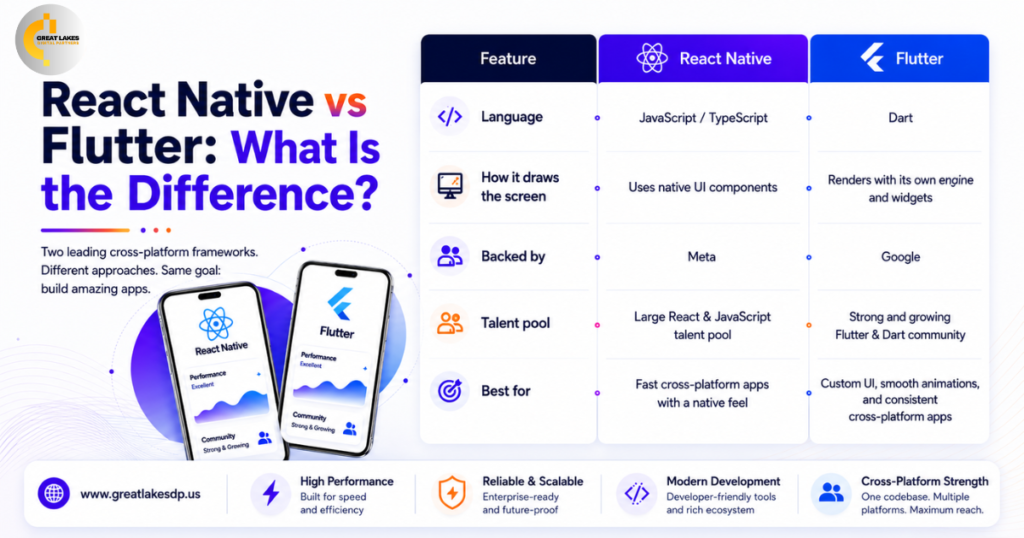
The main difference is the programming language and how each one draws the screen. React Native uses JavaScript and shows content with the phone’s own native components, while Flutter uses Dart and draws every pixel itself with its Impeller engine. React Native, built by Meta, is a natural fit for teams that already know JavaScript or React. Flutter, built by Google, gives complete control over how an app looks on every device. Together, the two frameworks power most of the cross-platform app market today.
| Feature | React Native | Flutter |
| Language | JavaScript / TypeScript | Dart |
| How it draws the screen | Uses the phone’s native components | Draws every pixel with the Impeller engine |
| Backed by | Meta | |
| Talent pool | Very large (JavaScript developers) | Smaller (Dart developers) |
| Best for | Fast launches and JavaScript or web teams | Pixel-perfect, animation-heavy apps |
Flutter vs React Native Performance: Which Is Faster?
In 2026, both frameworks are fast enough for almost any business app, and the performance gap between them is small. Flutter has a slight edge for heavy animations and graphics-rich screens, while React Native offers faster startup and lighter memory use for standard apps.
The gap has narrowed because both have modernized. React Native’s New Architecture removed the old slow connection between code and the phone, and Flutter’s Impeller engine delivers smooth, consistent animations. The practical takeaway is simple: for around 90 percent of apps, performance is no longer the factor that decides the winner. Your team’s skills and your design goals matter much more.
Which Is Better for Startups and Enterprises?
React Native is often the better choice for startups that want to launch fast and hire easily, while both frameworks work well for enterprises. The right pick at the enterprise level depends on whether your priority is design control or fitting into an existing technology stack.
Flutter vs React Native for Startups
For startups, speed and budget matter most. React Native usually wins here because its large JavaScript talent pool makes hiring quicker and cheaper, and teams can often reuse code from a web app. That means a faster path from idea to a launched product.
React Native vs Flutter for Enterprise
In a react native vs flutter enterprise comparison, both frameworks are proven at scale. Google Pay and BMW use Flutter, while Instagram, Discord, and Coinbase use React Native. For enterprises, React Native fits naturally when the company already runs on JavaScript or web technology, while Flutter is a strong choice when a single, identical look across many platforms is the priority.
React Native vs Flutter: Which Should You Choose?
Choose React Native if your team knows JavaScript, you want a large talent pool, and you value a fast launch. Choose Flutter if you need pixel-perfect, animation-heavy design across many platforms. There is no single winner in this mobile framework comparison. The best choice depends on your team’s skills, your budget, and what your app needs to do. If you lean toward React Native, our complete guide to React Native app development services walks through the whole process, and our guide on React Native vs native app development covers another important comparison.
Build Your App with the Right Framework
React Native and Flutter are both excellent in 2026, and the right choice comes down to your team, your budget, and your design needs. A trusted partner can help you weigh these factors and avoid a costly wrong turn. Great Lakes Digital Partners offers React Native app development services in Michigan and beyond. Talk to our team for a free consultation, and we will help you choose the framework that fits your app best.
Frequently Asked Questions – React Native Vs FLutter
Q1. Is Flutter or React Native Easier to Learn?
For most developers, React Native is easier to start with because it uses JavaScript, one of the most widely known languages. Flutter uses Dart, which is powerful but less common, so it often takes more time to learn.
Q2. Which Is More Popular in 2026?
Both are very popular and together power most cross-platform apps. Flutter holds a slightly larger share of the market, but React Native benefits from a much larger pool of available developers.
Q3. Can I Switch from One Framework to the Other Later?
Switching is possible but usually means rebuilding the app, since the two use different languages. It is best to choose carefully at the start based on your team and goals to avoid that extra cost.
